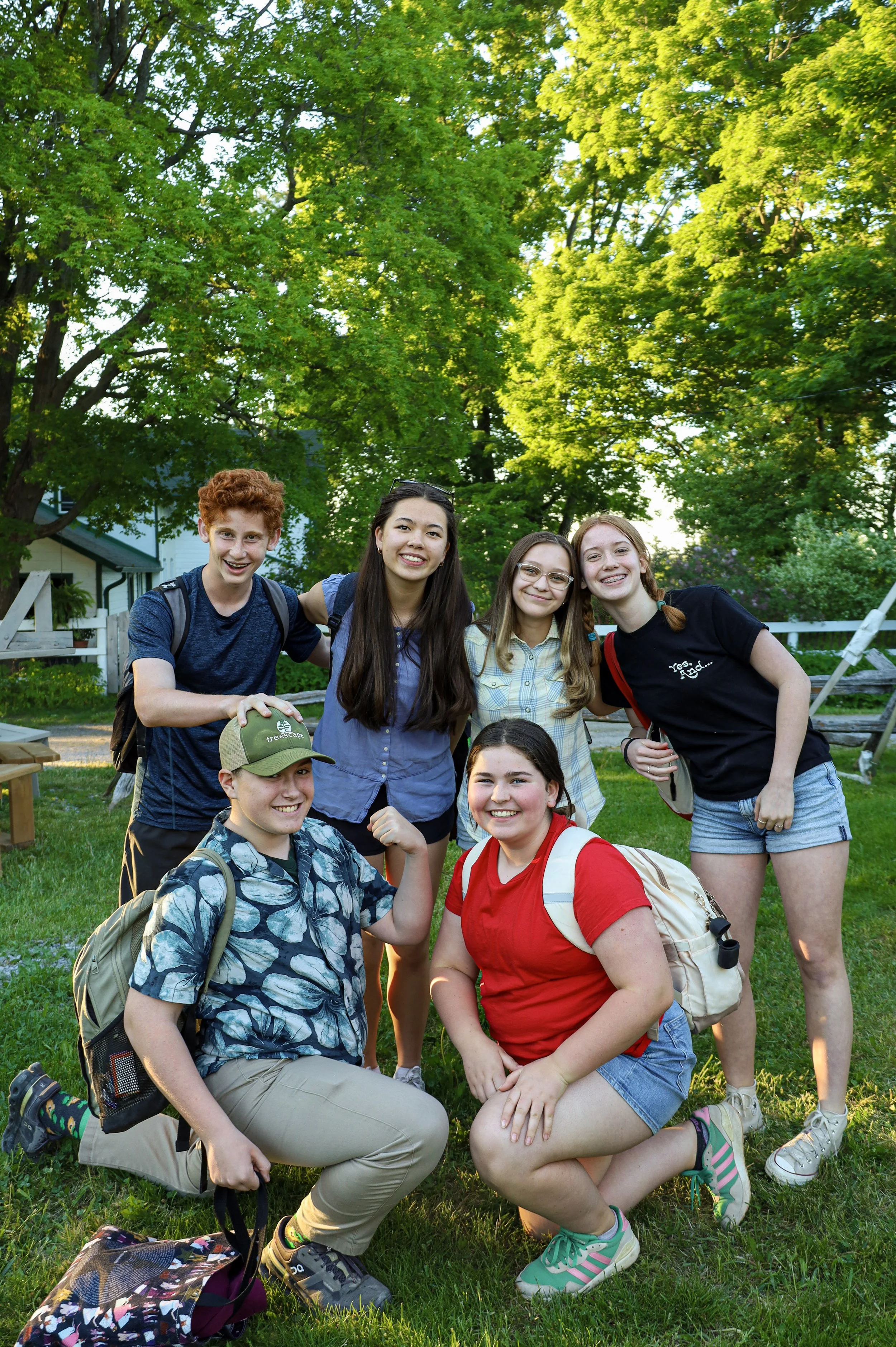
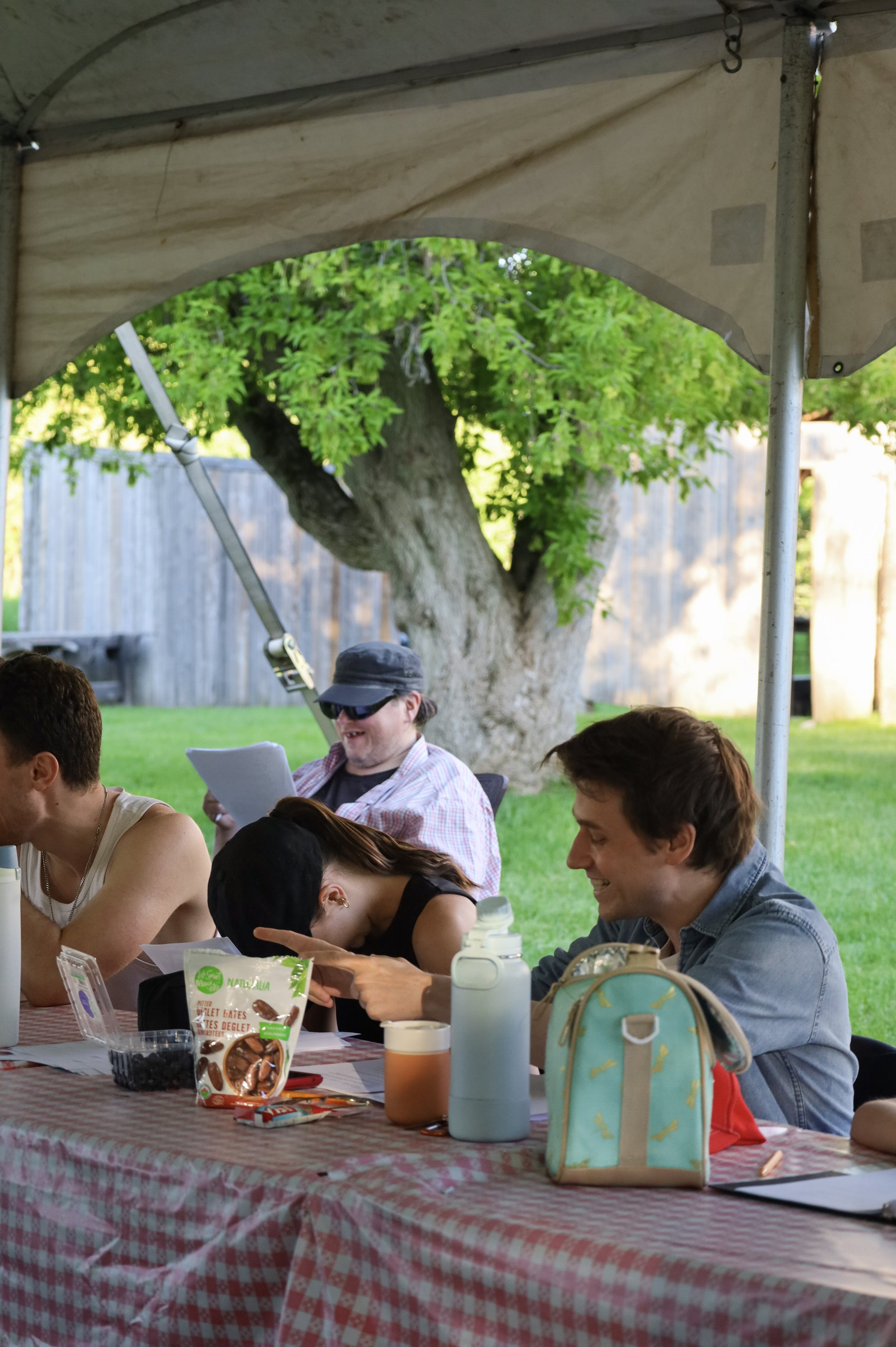
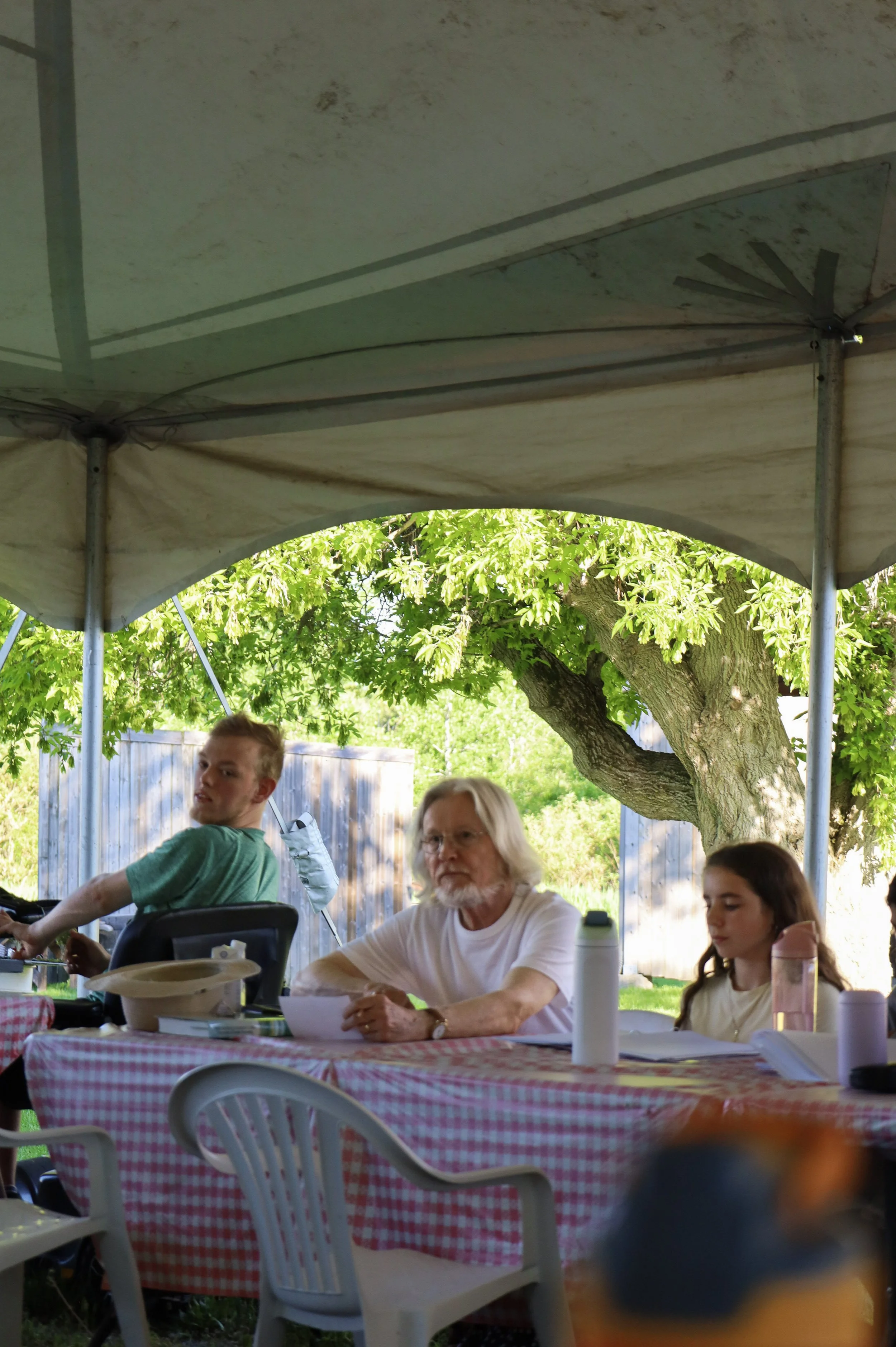
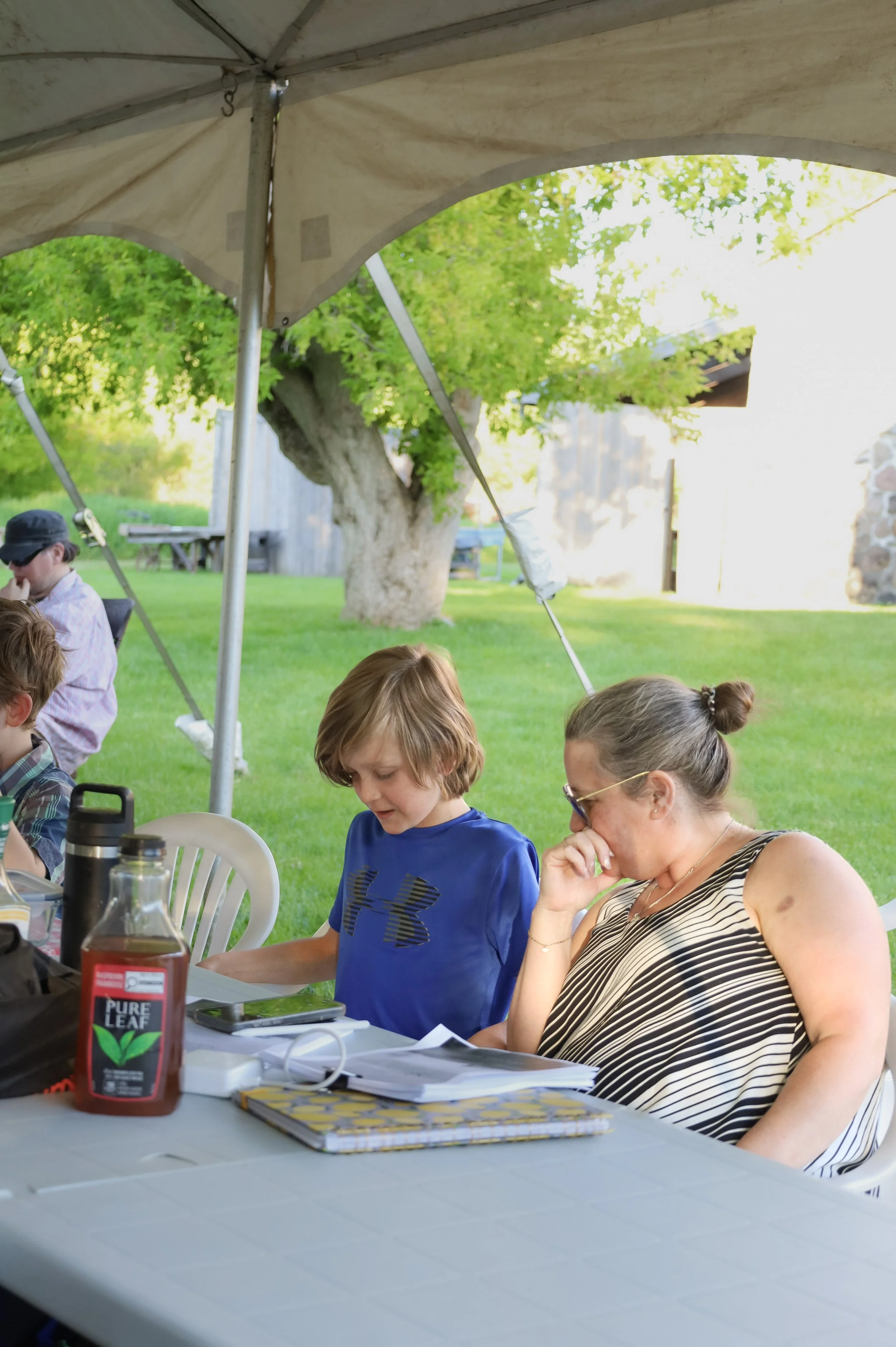
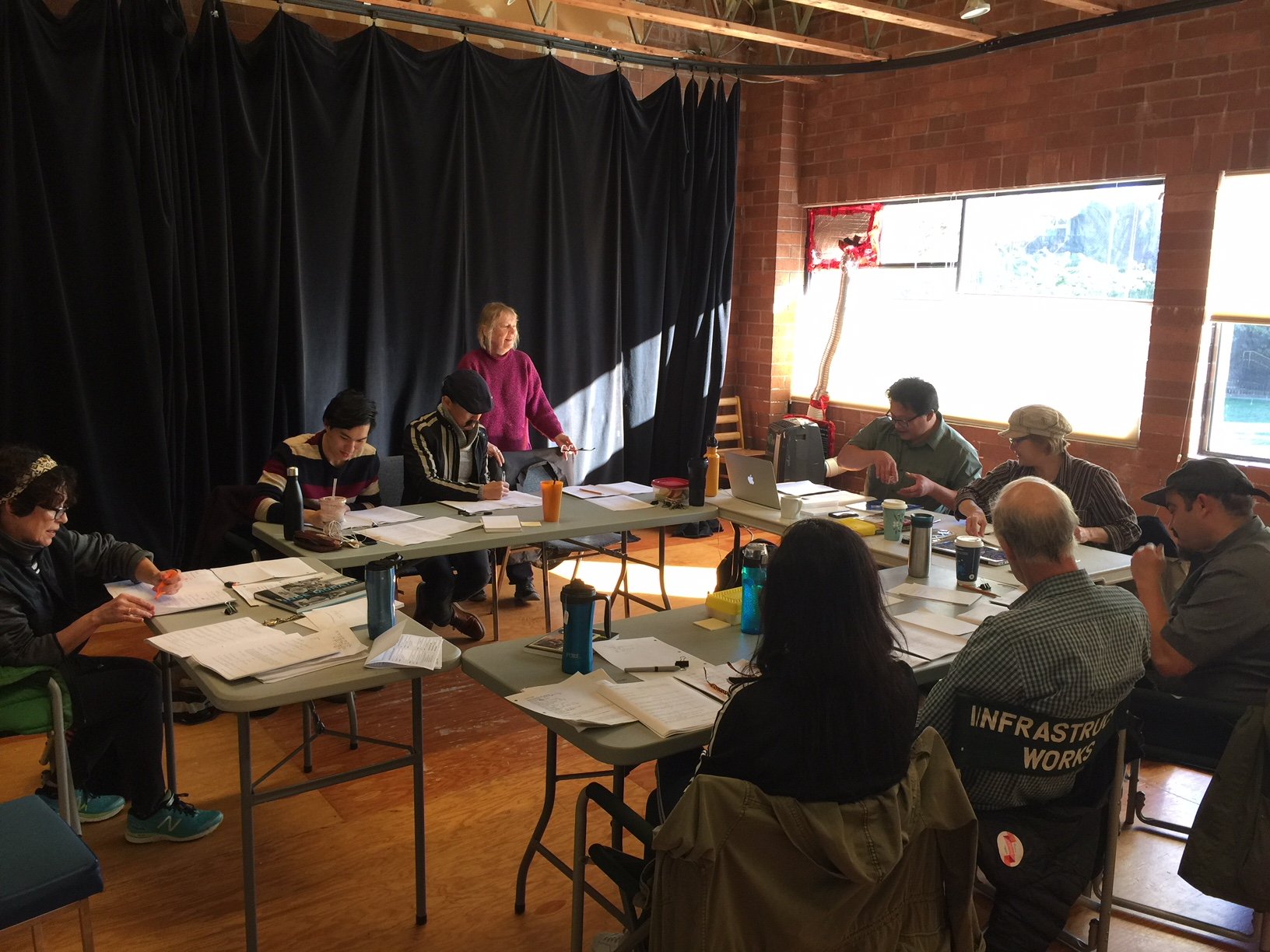
This past week, I was able to attend the initial read-through and table work for this major revival of my 2006 play Schoolhouse… which was directed at the 4th Line Theatre by Kim Blackwell in 2007, brought back by popular demand in 2008, and—despite its large cast and rural setting—has been staged somewhere in North America at least once a year ever since.
I haven’t looked at the script or seen a production in at least 15 years, so I was thrilled to bits to discover that the thing holds up. As well as being in awe of Monica’s casting, I fell in love with these characters and this story all over again… which isn’t immodest for me to say, I think, given that they were all inspired by real people and real events in the Cavan region, as told to me or read by me during my research here as an OAC and Canada Council for the Arts Playwright-in-Residence all those years ago.
Now that I’ve returned home, this complex little one-room ecosystem is entirely in the capable and sensitive hands of director Monica Dottor and her vast team of theatre professionals, community stalwarts, and truly irresistible children. I’ll be back at the end of June to see what they’ve made of it all.
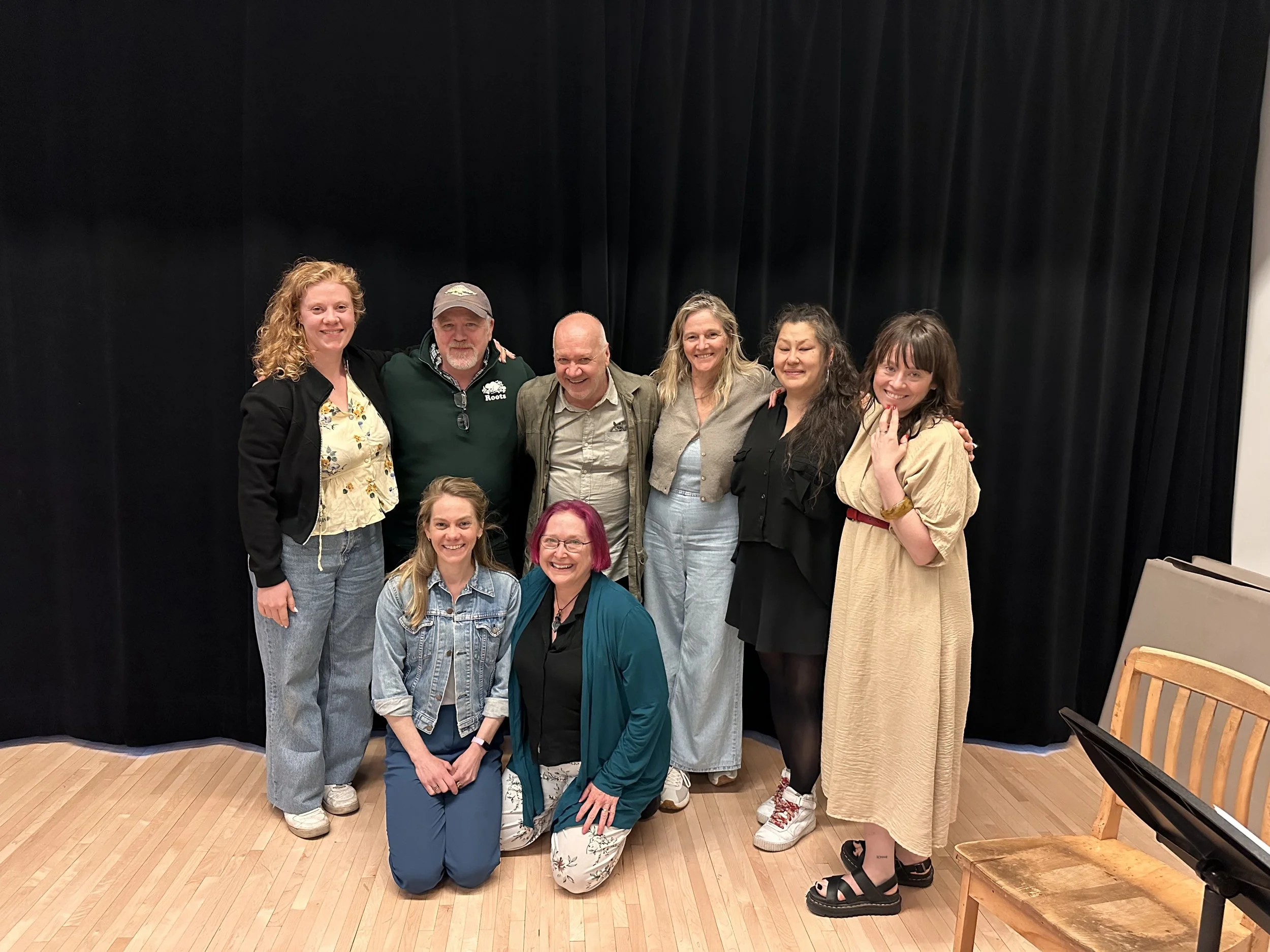
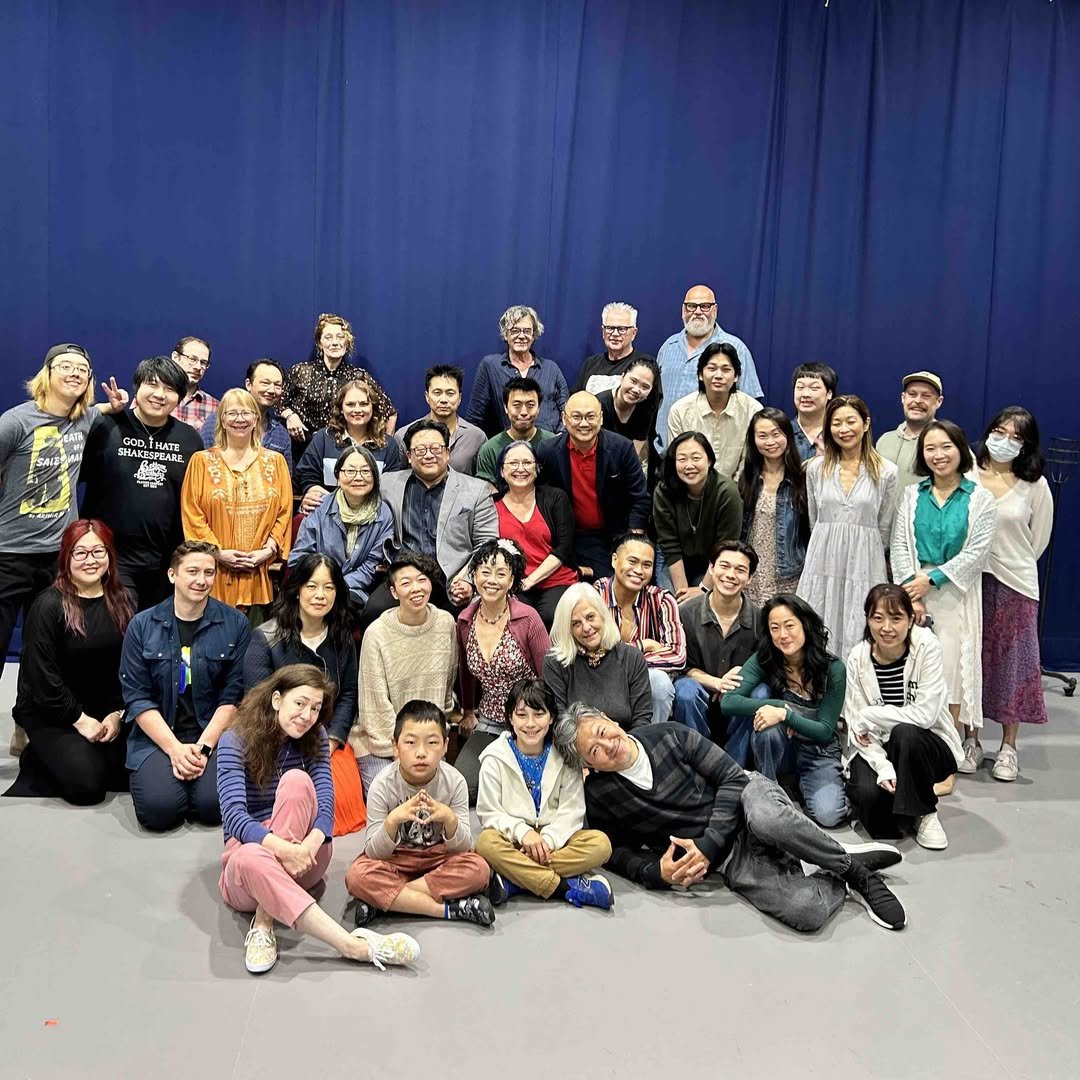
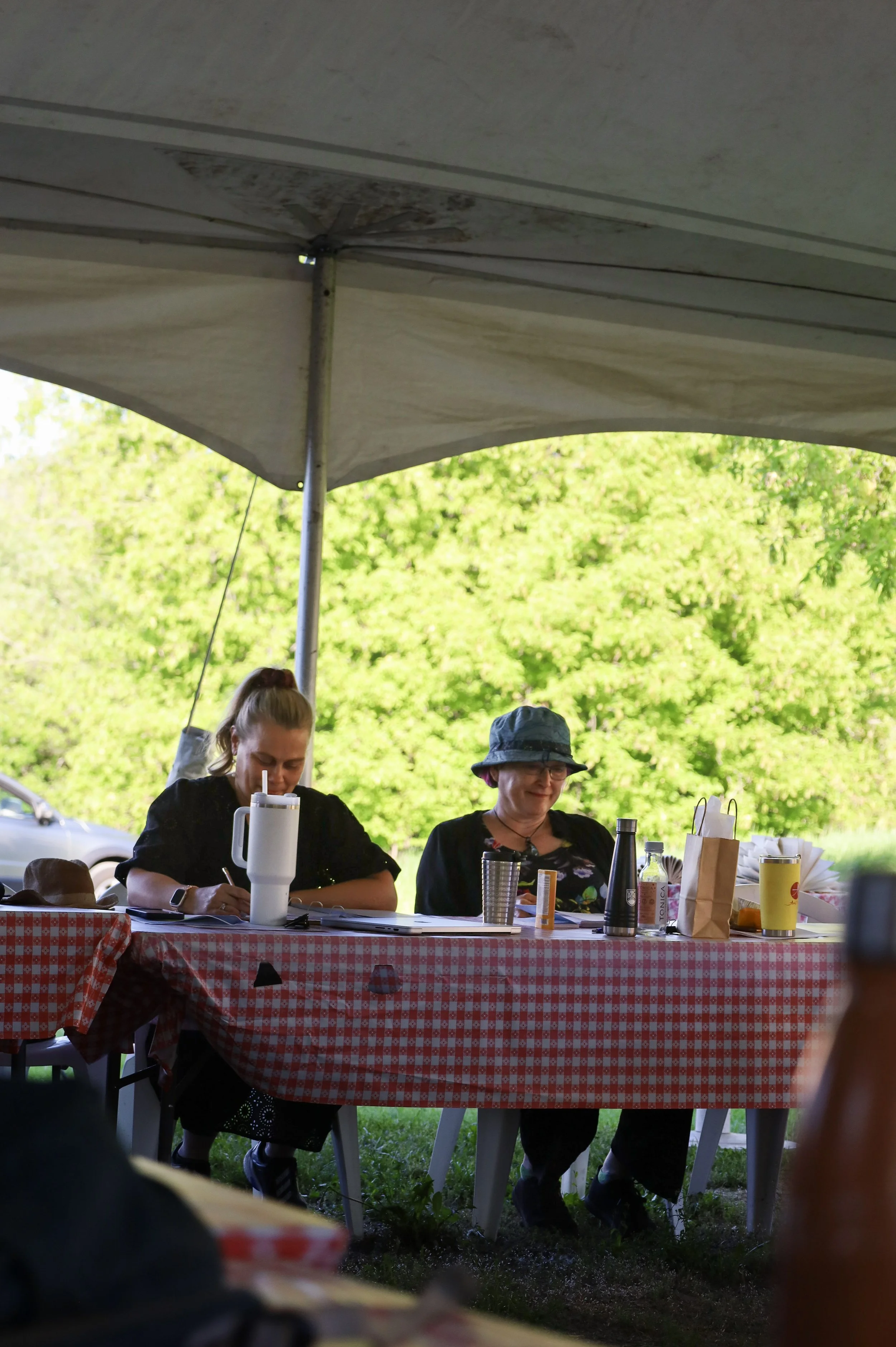
Pictured: some of the cast and crew of Schoolhouse at the 4th Line Theatre, previewing June 30 and July 1st and running July 2-25, 2026. Photos by Kiana Bromley.
Pop-Up Book Event for SALESMAN IN CHINA
Join us in Stratford if you can!
Those Who Have Vanished
At the end of May, my translation of Rébecca Déraspe’s THOSE WHO HAVE VANISHED received a very fruitful workshop at Concordia University, led by Mindy Parfitt of Vancouver’s The Search Party Theatre and featuring an excellent Montreal cast. I look forward to a further design-focused workshop with The Search Party in 2027, working toward a production of this powerful and award-winning feminist play about what it means to disappear from your own life... and what it means for those around you.
THOSE WHO HAVE VANISHED (French title: CEUX QUI SE SONT ÉVAPORÉS) translation workshop, May 2026. Standing L-R: Kathleen Stavert, Alain Goulem, Brian Dooley, director Mindy Parfitt, Julie Tamiko-Manning, and playwright Rébecca Déraspe. Kneeling L-R: Amelia Sargisson, Leanna Brodie.
The School Bell Rings Again in 2026
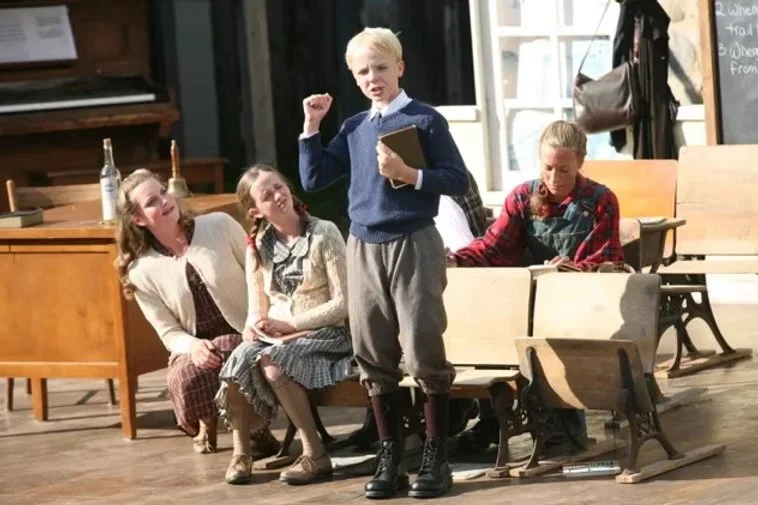
The 2007 4th Line Theatre production of Schoolhouse, directed by Kim Blackwell, a critical and popular success, was brought back for the 2008 season. Pictured: Shannon Taylor, Nora Hickey, Cody McMahon, and Jade O’Keefe. Photo: Wayne Eardley.
Schoolhouse is my most-produced play and still going strong, and that surprises me. Urban theatres tend to assume that anything about rural people is sentimental/unsophisticated (I’m still reading condescending reviews about the expressionist classic that was a touchstone for this piece, Thornton Wilder’s Our Town.) Moreover, the play’s cast size (10+ with doubling) has long been prohibitive for professional producers. Yet it has been embraced by dozens of conservatories, schools, and community theatres as well as by a decent number of professional companies, across Canada and as far away as Austin, TX and Fargo, SD.
This spring, Schoolhouse will be directed by Aaron Jan in a student production at the Randolph College of the Performing Arts in Toronto, ON.
This summer, it is returning to its roots… and mine. 20 years after its Blyth Festival premiere, and 19 years after the 4th Line Theatre’s landmark production by Kim Blackwell, Schoolhouse is coming back to the 4th Line Theatre in a brand-new production directed by Monica Dottor.`This is where it all began, with a residency in Millbrook that saw 4th Line founder Rob Winslow ferrying my burdensome non-driving self around Cavan Township and Peterborough, to museums and archives and research interviews and 4th Line’s patented “community soundings” where local people shared their stories of their years in the one-room schools and many of their recollections ended up in the play. I so admire what Rob and Kim and their teams have built in Millbrook ON: not community theatre, not the usual band of itinerant professionals with no connection to the terrain on which they work, but a high-level rural professional theatre deeply anchored in its community and place, both onstage and off.
I am looking forward to introducing this story to a new generation… ten miles from the village where I grew up.
The Tom Hendrys. Two upcoming productions of The Weight of Ants. And...
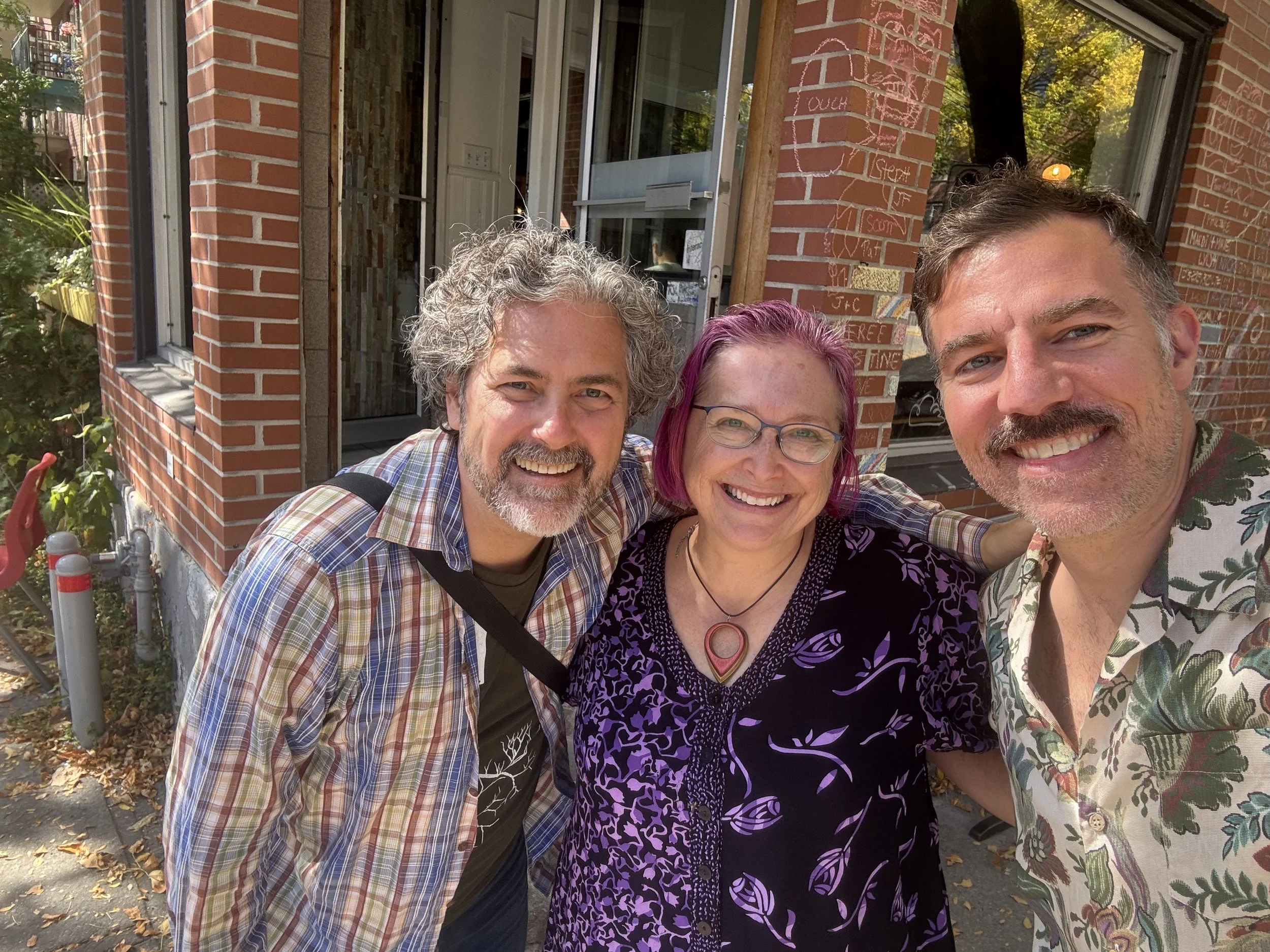
I started off the week over brunch at the charming L’Entrepots with my longtime collaborator David Paquet and the irrepressible Sam Buggeln, Artistic Director of Ithaca NY’s powerhouse company, The Cherry Arts. Having already produced the English-language professional premiere of David’s Jessie Award-winning play The Shoe, Sam is making it a double with his upcoming production of David’s Governor-General’s Award-winning play The Weight of Ants, directed by Dean Robinson. This was my first time meeting Sam, and I look forward to continuing this juicy collaboration.
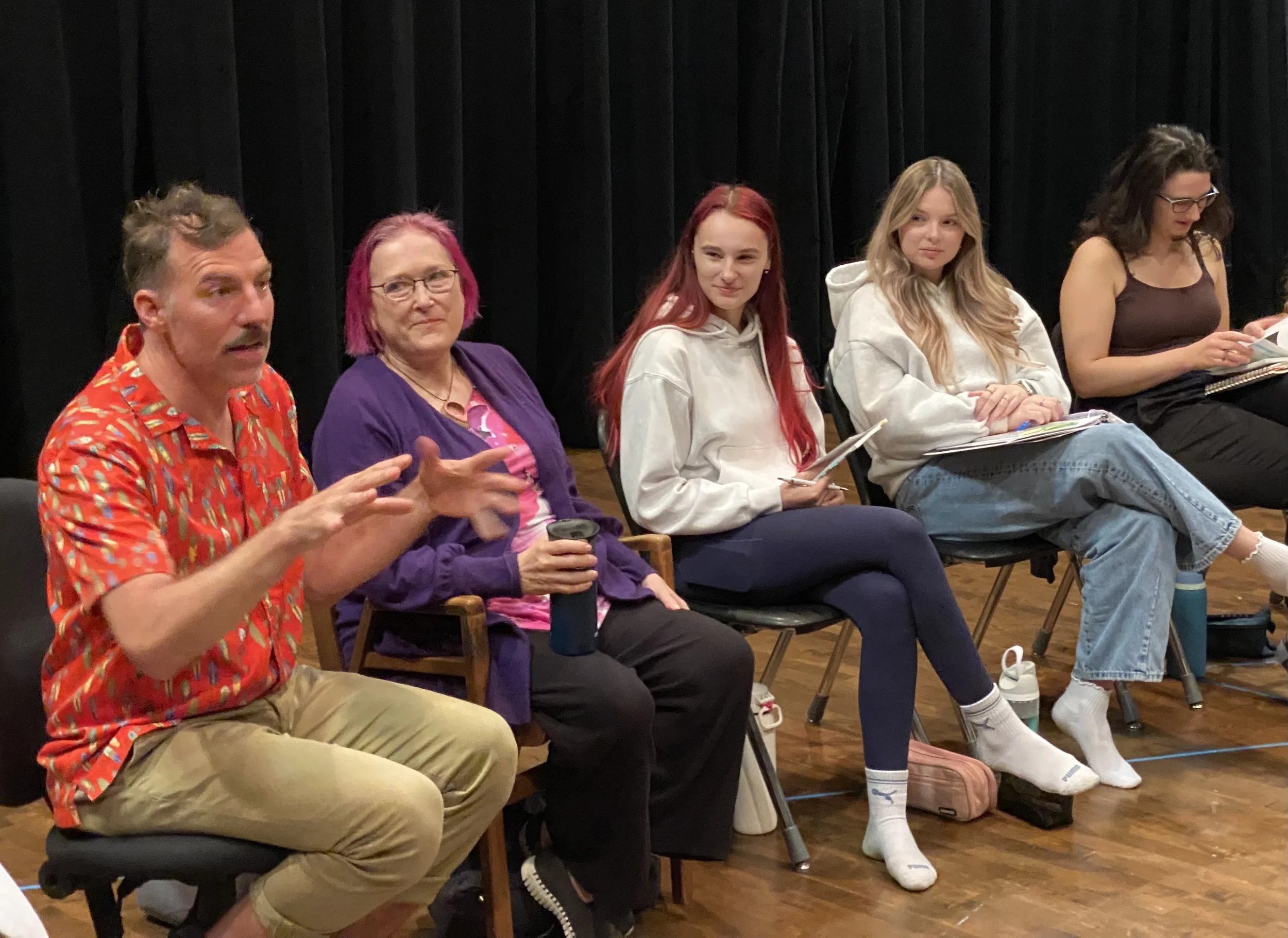
Next, I travelled to Saint-Anne-de-Bellevue with David Paquet and Zach Fraser to speak to Zach’s bright and inquisitive students, who are producing The Weight of Ants at John Abbott College.
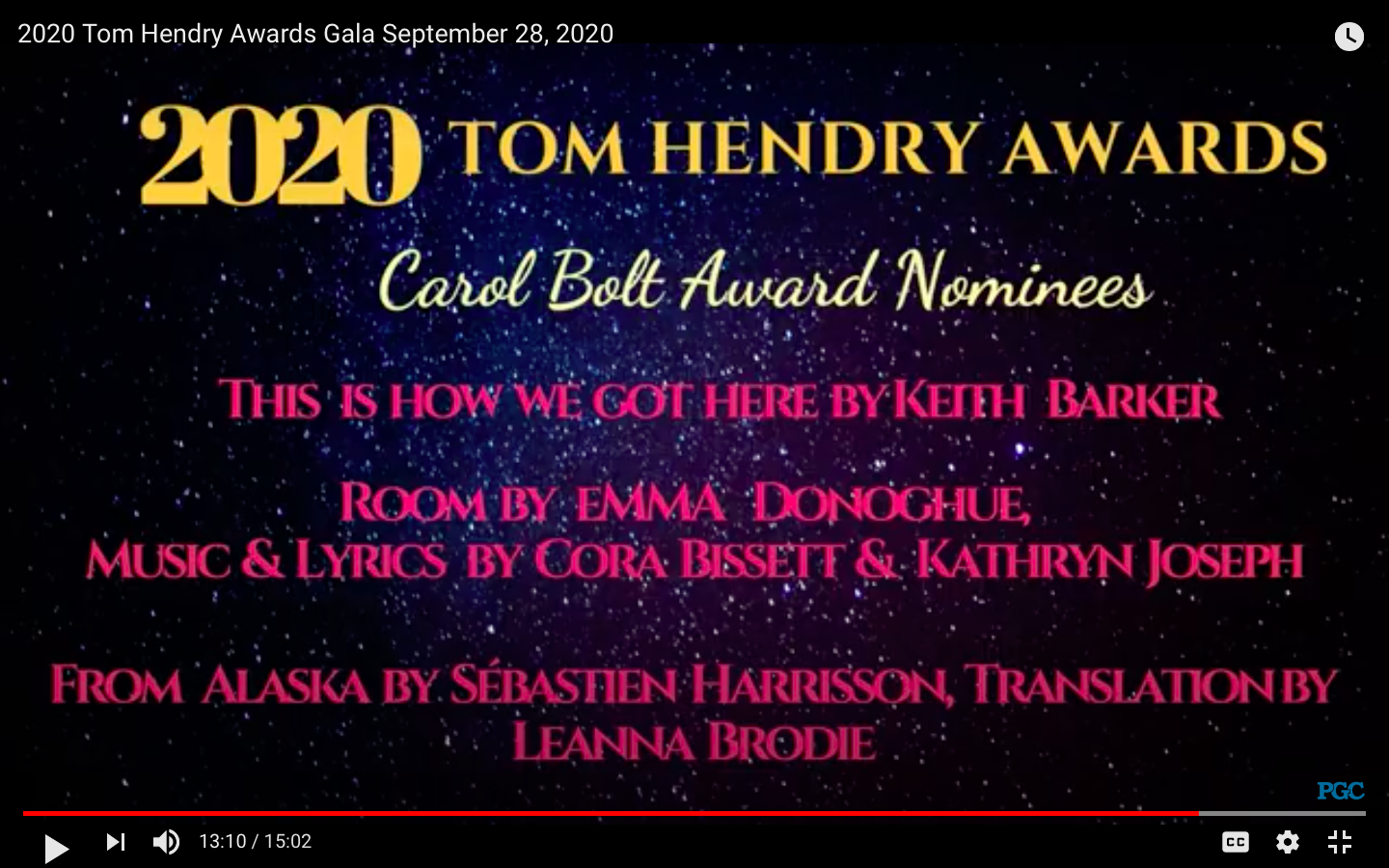
Then came the biggest news of the week: two of my projects have been shortlisted for the Playwrights Guild of Canada’s Tom Hendry Awards!
• Salesman in China, co-written with Jovanni Sy, is nominated for the Carol Bolt Award for best new play.
• Home Deliveries, my translation of Catherine Léger’s Deux femmes en or, is nominated for best comedy!
Have a listen to this PlayMe podcast, or go to this PGC web page, to find out all of the nominations. I will be tuning in to the awards announcements on the Playwrights Guild’s YouTube channel on Oct. 27 at 7 p.m. EDT [11 p.m.UTC] to hear the results. It’s a formidable field of artists this year, and I’m happy to be a part of the party.
I also just received confirmation of an upcoming production that I can’t announce yet. Stay tuned!
Where the Chicken Meets the Road: Thoughts on Translation
Brenda Robins and Kosta Ledermeyer in Sébastien Harrisson’s FROM ALASKA, directed by Michael Shamata at the Belfry Theatre, 2025. 📷: David Cooper.
[In honour of the recent English premiere of From Alaska – and because this week I am teaching a workshop on translation for the first time, at Playwrights Workshop Montreal – I am reposting this 2012 article, originally shared on the CROSSING BORDERS blog of the Theatre Communications Group. My thinking about translation has evolved since then, as has the translation I’m referring to: my questions remain pretty much constant.]
PART 1: WHY DID THE CHICKEN CROSS THE ROAD?
“Mais les mots SONT l’action.” That’s the passionate and cultured voice of Sébastien Harrisson, a young playwright from Montréal. We’re deep in discussion, in a room, in the Rockies, in Alberta, in Canada, in over our heads.
Yet here – in the rugged heartland of a country on which it’s my impression that francophone Québécois artists have largely though imperceptibly turned their backs – I have just leaped over a border that I’ve been staring at wistfully for years.
It's 2006, and Sébastien and I are at the prestigious Banff Centre for the Arts so that I can translate his luminous two-hander, D’Alaska. It is the initial project of the Banff-CEAD Translation Exchange… and it is not going well. My dramaturg is Maureen Labonté, co-chair of the Playwrights Colony and a leading translator of Québec drama into English: she is completely unimpressed with me, which she tells me in no uncertain terms. (In the first few days of the residency, having been swamped beforehand, I do a quick and dirty first draft just as a starting point for discussion: but in my joyous relief at getting SOMETHING on paper, I apparently come across as arrogant and sloppy. Maureen refuses to read anything until I do a second draft.)
Though not yet widely known as a translator, I’m a mid-career playwright with a number of published, regularly produced, and even academically studied plays, yet no one at the Colony knows my work: either because they’re from a different region of our enormous country, or because most of my plays have premiered outside Toronto (the rural/urban divide is a whole other border). Sébastien, meanwhile, has been nominated for a Governor-General’s Award, is hugely respected in Québec, and is building a reputation in Europe… but he’s unknown in English as of yet. So I hole up in my little room, revising, and both of us sort of flit through the halls like ghosts. The most accessible of Sébastien’s plays, D’Alaska recounts a blossoming friendship between a mercurial teenaged skatepunk and a seventy-something retired librarian. It turns out that they have both been abandoned by the one they love. In the case of the librarian, Maggie – her partner of forty years – has just left her to go on a cruise to Alaska. For deep-sea diving; underwater photography; and a much younger woman.
My eyes are old, Maggie
I try to decipher the little games of love
Being played beneath the arctic blanket
But my eyesight isn’t sharp enough now
All hearts are like enormous tomes in a foreign language
Do we become unfit for love as we age?
Do we become glaciers?
We ought to dive in the deep sea
Stop dipping our toes in it
Be without fear
Hold the breath and go down to see
See if what we perceive on the surface
Is really anchored to the depths
See if it’s not all just a snare, a mirage
Or if it’s solidly attached to the depths of us
And made to last
Beyond ourselves
And our petty opinions about things
The lamplight wavers, then goes out. Momentary blackout.
Maggie
Forgive me
For never having been able to understand
Except through words
That’s my first attempt at a key moment in the play, when the secretly dying “Miss” – as we and the skatepunk must call her, since she never reveals any other name – monologues to her absent, jilting lover. It’s an accurate translation, technically speaking; the words are quite close to Sébastien’s words; but as a moment of theatre, it just sort of lies there. In the original French, it shimmers. It soars.
Over the next week or so, progress is made. Maureen finally reads my text and is impressed that (for the honorific by which the older character chooses to be addressed) I have chosen “Miss” as the idiomatic equivalent to the French “Madame”: a tiny victory. Then the wonderful actors have a first go, and some moments are encouraging: that key speech, however, proves as inert in the mouth as it is on the page. Dead birds don’t soar.
I stop trying to fit in with the rest of the Playwrights Colony and discover that Sébastien and I can be our own colony of two. We walk scenic mountain trails and go to dazzling concerts put on by the jazz programme. My new companion is wickedly smart, erudite, and kind: the more I dig into his writing, the more I dig it, partly because it’s so different from my own. He buys me a scotch at the pub on my birthday, and we talk: about our work; about theatre: about how more and more young Québec artists – disenchanted with the sovereigntist movement after two very-close-but-no-cigar referendums on Québec independence – are discovering that they don’t need political separation to have all the autonomy they want. Buffered from the ROC (“Rest of Canada”) by a different language, a collectivist culture, and a flourishing and well-supported arts scene, they turn their attention to interacting – as Québécois – with Europe, with Mexico, with the United States, and beyond. Montréal’s Festival Trans-Amériques invariably lists productions as being from “Québec” or from “Canada”. Toronto – with the biggest theatre scene in Canada, and one of the largest in the English-speaking world – is four hours down the highway or an $18 ride on the Megabus, but most of the artists I have met in Montréal have never seen a play there, even though their English is more than equal to the task. (Meanwhile, most English-speaking artists I know would not be able to follow a Québécois show unless it was by the Cirque du Soleil.) When I mention Margaret Atwood to a literate stage manager friend in Montréal, she looks at me in blank incomprehension.
PART 2: TO GET TO THE OTHER SIDE.
My route to this particular border was twisting and strange. I grew up in a tiny homogeneous Ontario village and I’ve never lived in a Francophone environment in my life. But when it came time for me to go to high school, my poor widowed mother was in despair. I’d used every scholastic resource available in two counties, and I was bored bored bored. Moreover, any form of intellectual curiosity was a social death sentence. Enter the Toronto French School, a private school (with a generous scholarship programme) which at the time was a refuge for geeks and oddballs from around the globe. Mom made the gamble that I’d prefer to be miserable on account of being alone, far from home, at the bottom of the class, and not understanding a word that was said to me, than miserable because learning was impossible and the desire for it made you an outcast. Turns out she was right. That place kind of saved me. The fact that I fell in love with the French language and culture was a spectacular bonus.
TFS’s curriculum was very Eurocentric, and it took many more years for me to get connected to the hugely different language and vibrant theatre culture of Québec. As an actor and playwright in Toronto, I supplemented my income for many years by doing French-to-English translations for everyone from a dog food company to an educational channel. At last, with the great dramaturg Paula Danckert as pander and midwife, I was commissioned to translate my first play: Philippe Soldevila’s Conte de la lune. A few zigs, a few zags, and here I am at the Banff Playwrights Colony. Sometimes the chicken chooses the road: sometimes the road chooses the chicken.
PART 3: SO, NOW WHAT?
“It’s not about the words.” Séb and I are hanging out in my room. Our second reading is imminent and brass tacks are being got down to. Maureen has turned out to be a hugely giving mentor, and our sessions together are an intensive course in the sort of meticulous word-by-word consideration that she had expected from my first draft. However, to my surprise, when it comes to the dreaded iceberg monologue, she says, “You need to throw it all away and get inside the speech. Understand its function in the play. Use your intuition. Make it work for English-speaking actors and an English-speaking audience. It’s not about the words.”
“Look,” I tell Sébastien, “I’m not impugning your writing. It works BEAUTIFULLY in the French. All the imagery of icebergs and oceans are like this lovely white feather that your language keeps puffing up and up and up. Or a balloon carried off by the wind: we love watching how high it will go. But you guys have such a different aesthetic. And you have that whole rhetorical tradition in classical French drama, where Phèdre or whoever just takes an idea and runs with it. It’s a virtuoso turn, like an aria. It’s also one of the reasons why Racine and Corneille are so little produced in English: because we find those moments totally static. I mean, I’ve always hated the Queen Mab speech in Romeo and Juliet. It’s pretty and poetic and it stops the action dead. How the hell are you supposed to act that?”
He looks at me bewildered. He is trying hard not to take any of this personally, and by now he knows me well enough to succeed. “But,” he says – in French, the language we have been speaking – “The words are the action.”
It’s nothing I haven’t heard before: but somehow, in this specific context, that proverbial light-bulb switches on. Okay, I tell him: you need to walk me through this entire speech, and even through this entire play. I am going to ask you really stupid questions. I’m going to ask you to be explicit about stuff you have implied, or left ambiguous. And you’re going to agree not to get insulted or exasperated, because I need to understand this speech – its genesis, implications, and inner workings – even better than if I were going to act it.
I need to understand it as if I had written it.
So off we go. Sébastien is completely unpretentious and enormously patient. We talk about the Strasberg-tinged training of most English-Canadian actors, how we are activated by verbs, that it’s all about doing something to somebody (he is fascinated by this). We talk about how this not-overtly-political play begins on Canada Day, which has long been ignored in Francophone Montréal except as the day when renters’ leases are up and they move to a cheaper apartment. We talk about the specifics of same-sex couples, and the implications of a lifelong relationship that seems to dissolve without a trace. I suddenly remember being in Newfoundland, watching a “growler” – a tiny splinter calved from the big ‘bergs floating southward – melt away. An ancient shard of a giant and seemingly indestructible formation, slipping into nothing.
It’s one of the most memorable afternoons of my artistic life.
A few days later. The reading is electric. The room is abuzz. The firecracker Val Pearson reads the iceberg speech – re-imagined Anglo version – and it lights her up. Banff is a well-known launching pad, and a bright future for Sébastien Harrisson’s From Alaska seems assured.
Six years have gone by since then, and I am as yet unable to find a producer for this award-winning, funny, and very moving play: possibly because, in my culture, it crosses a line between theatre for adolescents and theatre for the general public; because it is too gay for some companies and not gay enough for others; because I am still not a part of the Canadian theatre establishment, and it is hard to get them to really hear me?
Borders…
I continue to work to get From Alaska produced and published, and I hope to work with Sébastien again one day. But nothing can take away from me the unspeakable rush of the divide that I came as close as possible to crossing, one afternoon, for a moment or two, after years of preparation and toil. The border between two cultures, but more than that. The border that actors, writers, and translators are always trying to sneak across. The border between two minds.
Time marches on, Maggie
And my eyesight isn’t what it used to be
The heart seems to me, now, like a weighty book
In a foreign language
Have I become too old for love?
Too blind, too slow, too cold, like a glacier?
Is our love an iceberg solid as an island
Ready to stand the test of time
Or a mere fragment, melting in the sun
Rolling over and over
Until it is only a stain on the water
An oily ghost
I need to know
But I’m too weak to make the descent
Dive, Maggie, dive
Don’t dip your toe in the water
Let go of fear
Take a deep breath and go down and see
If what was there on the surface
Is all that there is
See if it’s just a trap, a mirage
Or solidly anchored to the ocean floor
Vast and firm beyond our imaginings
And made to last
Beyond
Ourselves
And our petty pronouncements
Our tempests in a teapot
Our
The lamplight wavers, then goes out. Momentary blackout.
Maggie
Forgive me
I could never understand
Except through words
UPDATE: I have now translated 3 of Sébastien Harrisson’s plays – including Two-Part Inventions and Becoming Chelsea – and From Alaska finally got its day in the sun at the Belfry Theatre in 2024: my translation was a finalist for the PGC Tom Henry Awards in, I think, 2022. Its birth was a lesson in NEVER giving up. Thanks, Séb. Thank you, Michael Shamata.
Developing SALESMAN IN CHINA
Salesman in China is at the National Arts Centre this month. Researching, co-writing, and developing this story been a huge part of the last ten years of my life, culminating in last summer’s gorgeous Stratford Festival production, stunningly directed (as well as co-written) by Jovanni Sy. Now we are bringing this show to our nation’s capital as part of Niña Lee Aquino’s NAC season… and, with widespread critical acclaim and remarkable audience response, there is a lot of interest in future iterations.
I hope to post more sorely-needed updates to this site over the coming weeks, but meanwhile wanted to draw your attention to some articles on this site where you can see moments of our process for this production. Starting with this remarkable photo of Li Shilong and Mi Tiezeng – two of the original actors in Ying Ruocheng and Arthur Miller’s incredible-but-true 1983 production of Death of a Salesman at the Beijing People’s Art Theatre – whom we met and interviewed thanks to our beneficent fairy godmother (and Ying Ruocheng’s co-autobiographer) Dr. Claire Conceison. Claire also introduced us to our brilliant Chinese translator, Fang Zhang. You'll see their photos on the pages of this web site, too.
Li Shilong and Mi Tiezeng stand in front of the photo of their younger selves as Biff and Happy in Arthur Miller’s landmark 1983 production of Death of a Salesman at the Beijing People’s Art Theatre. Photo by Leanna Brodie, 2017.
A very incomplete sketch of our process:
Around 2014: I read Arthur Miller’s Salesman in Beijing and immediately propose to Jovanni that we adapt the story into a play. He says yes. After over 20 years as a couple, it will be our first artistic collaboration ever, and only the first of many huge risks we will take together on this project.
2016: Small research/writing grant for me from City of Richmond BC. I discover the autobiography that Ying Ruocheng co-wrote with Dr. Claire Conceison, Voices Carry: Backstage and Behind Bars During China’s Cultural Revolution and Reform. Some time later, I reach out to Dr. Conceison, who becomes an important ally in the play’s development.
2017: Jovanni and I begin 3-year writing residency, The Associates, with Playwrights Theatre Centre, Vancouver, to work on Salesman in China.
June 2017: Jovanni and I travel to Beijing with PTC dramaturg Kathleen Flaherty. Thanks to Dr. Conceison’s connections, we are able to tour the Beijing People’s Art Theatre; see a rehearsal of their signature play, Lao She’s Teahouse; and meet associates of Ying Ruocheng, including Li Shilong and Mi Tiezeng.
2018: Working on the play at the Stratford Festival Playwrights Retreat.
Fall 2018: A reading at PTC.
Fall 2018: The Wuchien Michael Than Fund is so essential to the flourishing of Asian Canadian art and artists in this country, and we were grateful for their support.
2019: This time ted witzel brings us to Stratford through the R&D Lab, where we make some important discoveries about how the multilingual nature of the play is going to work. Banff, around this point, comes on with Stratford as co-commissioners of the play. (Colin Rivers of Marquis Literary works his usual magic, and Antoni Cimolino and Brian Quirt having the audacity to support this impossibly epic endeavour.)
2020: 🌎🎭💤
2021: Thanks to Brian Quirt, we are part of the Banff 2021 Playwrights Lab (Virtual Edition), including a very informative Zoom reading of Salesman in China.
Spring 2022: After a fruitful translation-focused workshop at the Banff Centre with our translator Fang Zhang, assistant director Nick Wang, cultural consultant/translation dramaturg Prof. Steven Liu, and dramaturg Bob White, we have our first reading and workshop of the fully bilingual script in Stratford. Shortly after this, we are on a production track at Stratford.
Summer 2023: Design workshop for Salesman in China at Stratford. It turns out to be a crucial step, not only for unlocking our approach to surtitling, but also because it allows Jovanni and our designers to evolve a process and language for working together. (In 2024, production staff at the Festival are astonished at how smoothly our show comes together during tech week. As well as Jovanni’s clear communication, and the vision, dedication, and generosity of the designers, I think this is part of the reason why.)
2024: Premiere of Salesman in China at the Stratford Festival. A phenomenal experience. I think we pretty much surpass all expectations, including our own, and we do it on the shoulders of every single person involved in this production. And on the wings of a truly inspiring story.
Jury. Duty.
(This is as close as I am ever going to get to a Siminovitch Prize!)
Sitting on an arts jury is humbling, demanding, and almost always thankless. But this year’s Siminovitch Prize for playwriting was the most agonising and exhilarating jury I've ever been a part of.
Agonising because we were presented with a large number of unique and exceptional writers, each of whom is eminently worthy of recognition and encouragement. And because, since I am a mid-career artist myself, with ties to multiple communities… many of this year’s candidates are my friends.
Exhilarating for the exact same reasons. With all the current challenges to our art form and in the world, here is a whole generation of extraordinary storytellers at the top of their creative powers who continue to pour their sweat and their genius into the theatre. Each candidate had multiple champions who cared enough to write fervent support letters; assemble well over a hundred pages of documentation; build a case for why a particular individual and their work should be lifted up to the nation. And many of them are my friends.
On the heels of my encounters with aspiring and emerging playwrights while teaching last year at UBC, this cross-country relief map of brilliance has left me further heartened and inspired.
Our jury combed through the applications; we pored over the criteria; then we talked passionately for days. It was painful. It was electric. Someone had to do it. While there will inevitably be disappointment as well as elation as the names are announced, the artists on that jury demonstrated great integrity and, I think, took this on as an act of love for this community. I am extremely proud of our list: I am deeply in awe of many writers who are not on it, too. I so appreciate the Siminovitch Foundation's monumental generosity to our community as a whole, and also the chance to shine a light on just a few of the indelible voices across this occupied land. If I could send one message to all of the remarkable artists who were in contention this year, it would be this: "We see you. You matter. Keep going."
https://siminovitchprize.com/jury/
Graduation
The moment when the Class of ‘23 were asked to look around and acknowledge their friends and family.
Today was a rite of passage for thousands of UBC students, including the graduating MFA and BFA candidates from the School of Creative Writing, where I have been the Assistant Professor (Playwriting) for the past year.
I was there to honour my students, of course, and I was delighted that I got to offer most of them a quick word of congratulation as they went by. They all smiled or clasped my hand in return, justly beaming with pride in their own accomplishment. I had been offered a chance to gown up and join the faculty procession, but with my one-year interim appointment now drawing to a close, that just didn’t feel right to me: I was happier to cheer them all on from afar, including colleagues Annabel Lyon and Stephen Heatley who have been so kind and helpful to me.
As the students hit the designated photo spots, I was amused by all the heavy-metal finger gestures and tongue-out posing, and delighted by those who managed to memorably express their individuality in a sea of black robes (a head of brilliant orange-and-white cornrows; a gown topped by a vibrant ribbon of flowers). I was also deeply moved by the teen sitting at the back who shouted “Go, Mom!” and, later, the student who carried her toddler on her hip, all the way across the stage.
It felt in a way as if I were graduating, too. This year, I pushed myself to do endless numbers of things I have never done before. I redesigned and taught 3 university courses, including 2 with a mix of graduate and undergraduate students: this involved developing, scheduling, weighting, explaining, and grading assignments as well as developing dozens of workshops/lectures/craft talks. I redesigned and co-led a new play festival, with the help of some of the most brilliant and generous artists in the Vancouver theatre community and the incredible support of the Arts Club Theatre and Playwrights Theatre Centre, as well as a hard-working team of student producers who pulled out all the stops. I learned new software, AV systems, academic and human resources policies, pedagogies, decolonising and anti-racist strategies, resources for students in distress… and unfortunately, what to do when a student tries (in a few cases very, very hard) to manipulate you. Hell, I even taught a class on data storytelling to 200 people!
I soon learned that, in my first year, I was never going to do all of it perfectly (or even particularly well), but that I had to keep doing what actors must do whenever we make a mistake: own it, learn from it, forgive ourselves for it, and move on. At least I have the satisfaction of knowing that I sweated blood and worked my ass off to make this year a positive and meaningful experience for these students. I truly gave it everything I had.
I’m a better teacher because of everyone I taught and worked with this year. I am also a much stronger person! Still, it was gratifying that the grumpiest customers were more than balanced by those bright sparks who let me know that my classes left them feeling inspired by theatre, emboldened to tackle new media, invigorated by meaningful exchanges with senior artists, more confident and competent within their own voice. Honest criticism is crucial in learning to do better: appreciation, connection, and growth remind us why we try at all.
Congratulations, UBC School of Creative Writing Class of ‘23. May you go out and enrich your world as you have already enriched mine.
Wildfire at La Chapelle, and my origin story
Davide Chiazzese, Kathleen Stavert, and Julie Tamiko Manning in Jon Lachlan Stewart and Philippe Cyr’s production of Wildfire, my translation of David Paquet’s Le brasier. Talisman Theatre at La Chapelle, Montréal. Photo by Maxime Côté
Just one more little update. Reviews for Wildfire in Montreal have been phenomenal and it closes this weekend. Two-time Governor-General’s Award winner David Paquet has been produced in a dozen countries and languages, but this is the first time the English-speaking public in his own hometown has ever had access to his work… with French surtitles and ASL interpretation to widen the circle even more. Kudos and gratitude to the entire company.
Meanwhile, if you want to know how a unilingual kid from Bewdley, ON becomes a theatrical translator: it’s all in this article!
"Wildfire was sublime! Such an incredible and inspiring piece. The text is layered, complex, innovative and human and the performances are so unique, rich, full and stunning."
--erinjlindsay, 2023-01-16.
montreal rampage : "The performance by the actors is... outstanding. [...] Wildfire is devilish and delightful. ... The result is satisfying and the production is a great success."
--Rachel Levine, 2023-01-17.
Sur les pas du spectateur : "'Consumed' (!) and very satisfied by Wildfire. [...] The text is rich, the exchanges lively and, even if it is in English, I am very, very attentive, and often laugh too!"
--Robert St-Amour, 2023-01-17.
atavu.ca : Wildfire "Hats off to the artists!"
--Jérôme Bouclet, 2023-01-18.
CJAD iHeartRADIO : "Wildfire is a biting, witty surreal romp, with a spare but gorgeous staging, and delicious acting."
--Sarah Deshaies, 2023-01-20.
mcgilltribune.com : "Wildfire is a blazing success... sardonic humour and twisting, cyclical storyline will offer audience members on both sides of the aisle plenty to talk about."--Dana Prather, 2023-01-24
UBC. Watch This Space.
Life = change.
Theatre = change.
Pandemic = change = life = theatre.
Straight out of University of Calgary’s MFA programme, I am working for one year as Assistant Professor (Playwriting) in the School of Creative Writing at the University of British Columbia.
I’m back in Vancouver.
My hair is blue.
My life is a constant state of discovery.
The students are remarkable.
I have no time.
When I have time, I have no more brain cells.
But it’s good.
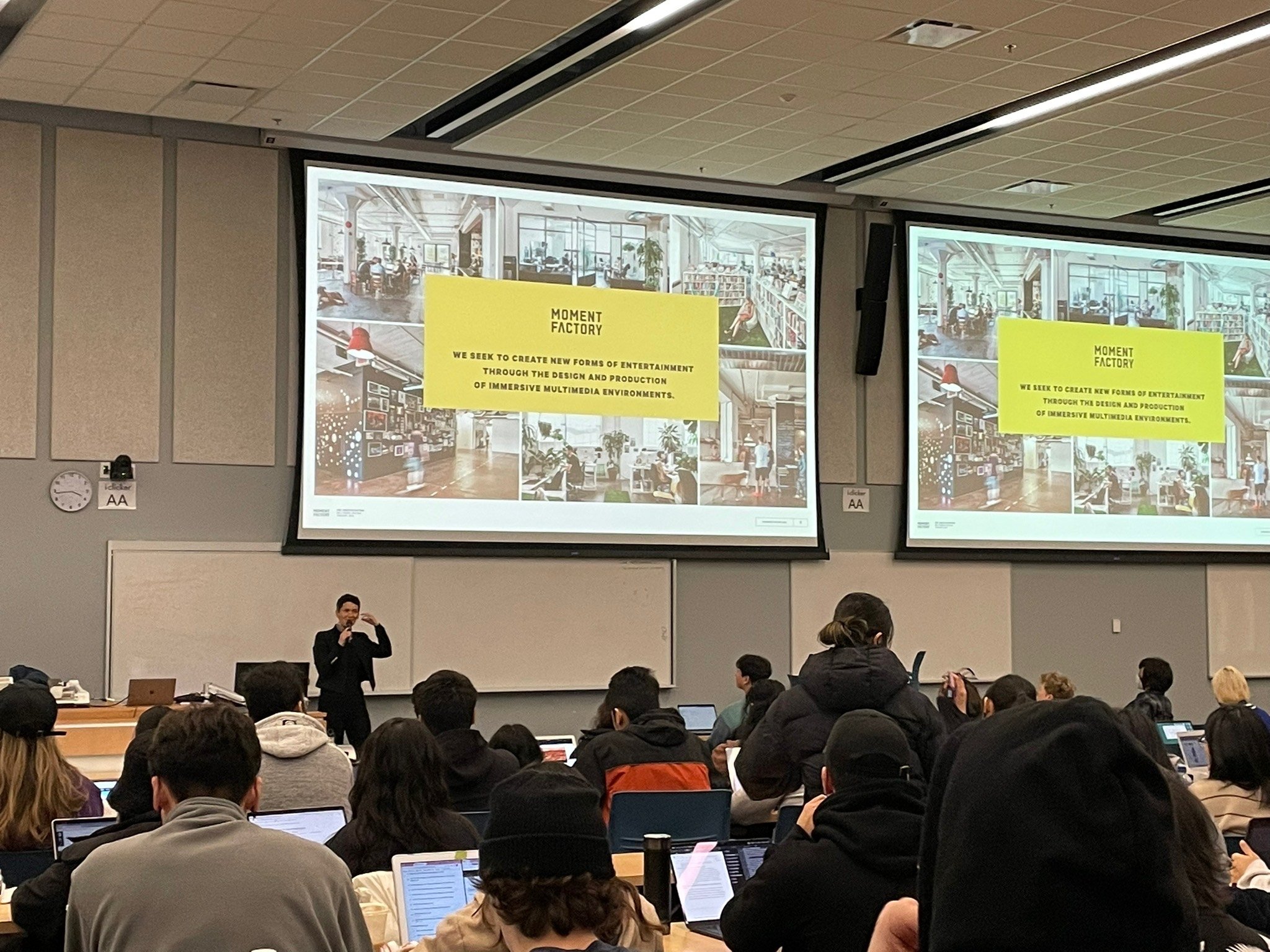
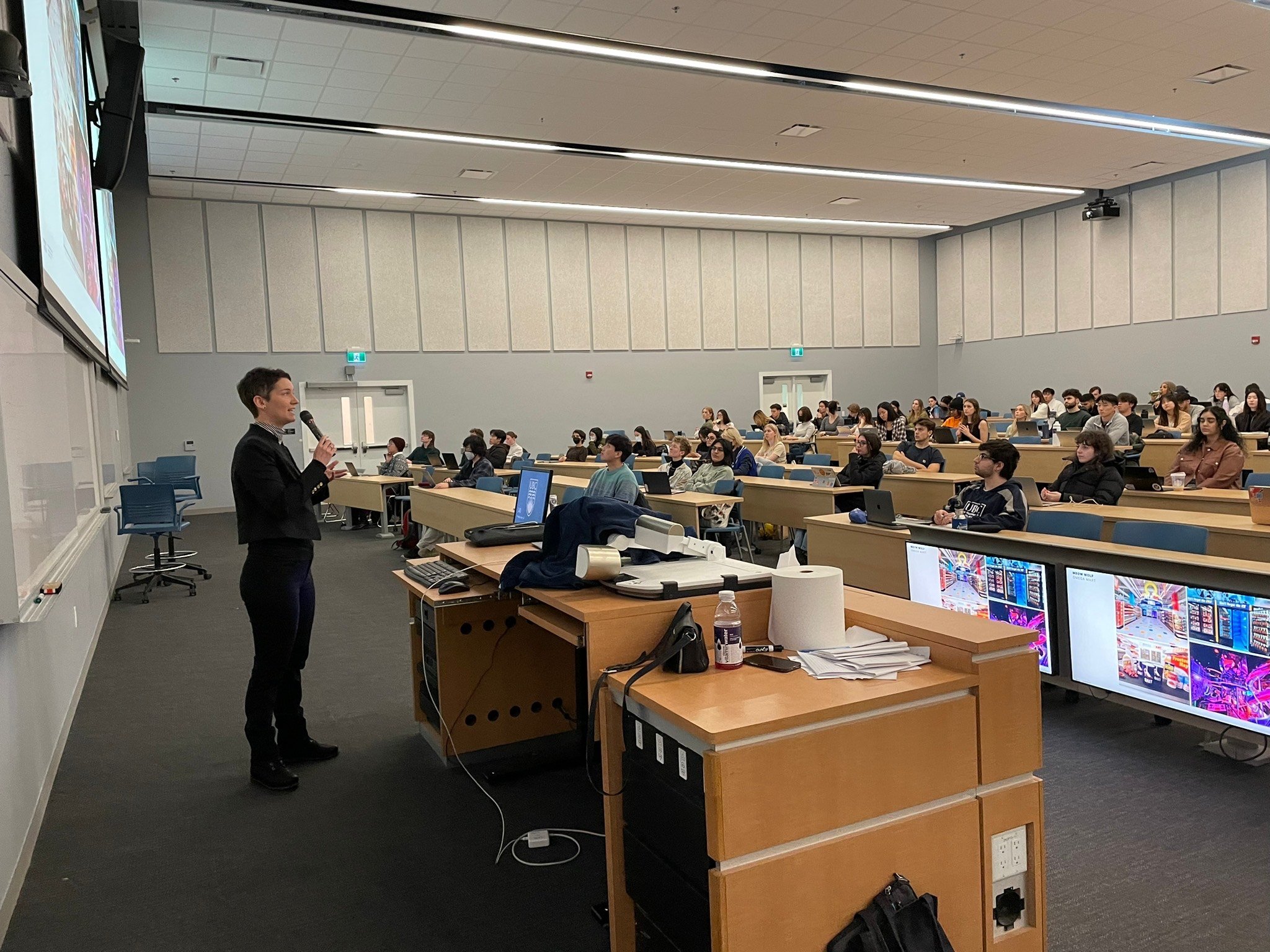
One day soon I will write about what I’m doing and experiencing here. In the meantime, here are some photographs of the wonderful Amy Chartrand, Creative Director of Montréal’s internationally renowned immersive multimedia studio, Moment Factory. She’s giving a phenomenal workshop this week and next, to my New Media class and also Professor Jennifer Moss’s. I’m proud and grateful to have brought her and some of my favourite artists and creators in to talk to/work with my students: Carmen Aguirre, Chirag Naik, Joanna Garfinkel, David Yee, and Jovanni Sy. Much more to come this semester.
I have a show on in Montreal getting wonderful reviews, and am involved in two more – Red Phone and Clémentine – coming up this month in Vancouver. This fall, as I started this job, I published I Am William and Wildfire & The Shoe, premiered a play, and won a Dora. Broke my foot. Moved.
Stay tuned for real updates. Right now, the new stuff is a firehose, and these students come first. Thanks for checking out the site.
Banff Playwrights Lab 2021
Banff Centre for the Arts 2021 Playwrights Lab, all-digital for the first time ever. This was meant to happen in person in 2020, but I need it even more now. I’m working on co-writing the play Salesman in China with Jovanni Sy.
I am disappearing into this marvelous opportunity from May 3-May 14, 2021. If you need me urgently during this time, please contact my agent. Thanks, and I’ll be back shortly.
I AM WILLIAM at the Stratford Festival!
Very excited that the cat is finally out of the bag! Rébecca Déraspe is one of Québec’s leading dramatists and, having developed the translation of I Am William with the wonderful Théâtre Le Clou and Sylvain Scott, I am thrilled that Esther Jun is bringing this witty, funny, surprising and deeply felt play to Stratford audiences.
Online Reading of Philippe Soldevila's AN EMIGRATION TRILOGY
Yes, yes, I’m vacillating about the title!! I’ll probably go with AN EMIGRATION TRILOGY, in the end.
Philippe Soldevila’s Tales of the Moon was inspired by his own family’s history in post-Civil War Spain as well as by the stories of Catalan writer Pere Calders. It was, in fact, my first-ever translation; Tales of the Sun is my most recent one; and in between comes the wry first-generation Canadian tale, Tales of the Snow. All together, they comprise An Emigration Trilogy, which recounts the Soldevilas’ epic journey from Valencia to Montréal and back again… told through the eyes of four generations of children. Join us for one or for the whole hugely ambitious saga: the plays all fit together but also stand alone. Once again, John Jack Paterson of BoucheWHACKED! Theatre is bringing us a completely different vision of what theatre for children is capable of. Phenomenal cast, too. Thanks, by the way, to Playwrights Workshop Montréal for facilitating Moon and launching me into theatrical translation. The other two translations were commissioned by BoucheWHACKED!, supported by the Canada Council for the Arts. The readings will take place March 14, 21, and 28.
Schoolhouse at Two Planks and a Passion
I am proud that Schoolhouse will be opening Two Planks and a Passion’s 30th season at the beautiful Ross Creek Centre for the Arts in Canning, Nova Scotia. Ken Schwartz has been scheming away at producing and directing this play for several years now, and thanks to the beautiful outdoor setting and the success of the “Atlantic bubble”, it looks like it may finally be a go! The production is scheduled June 24- August 14, 2021. I do hope I am able to attend: I have lovely memories of seeing The Odyssey there when Acadia brought me in for their production of The Vic… and later, of dropping in while on our way to Cape Breton, where we spent our honeymoon!
Turbulence at the Alchemy Festival, Feb. 27
A half-hour excerpt of my new play, Turbulence, is getting an online reading at the University of Calgary on Sat. Feb. 27, 2021. The wonderful Clare Preuss is directing a cast of undergraduate students. You are welcome to sign up for a spot and join us.
Turbulence has had a turbulent history. A documentary play by the same name was commissioned ten years ago by Lighthouse Festival Theatre, the 4th Line Theatre, and the Blyth Festival, with the support of the Ontario Arts Council and the Canada Council for the Arts. I then embarked on an epic quest to chronicle the roiling wind power controversy that redrew the political map of Ontario; created a grievance-driven rural protest movement (which led ultimately to the election of an anti-environmentalist right-wing populist to the premier’s office); and divided communities and even families.
I interviewed dozens and dozens and dozens of people, went to wind power conferences and Conservative party policy conferences, criss-crossed hundreds of miles, gathered thousands of documents, and created mountains of transcripts (including almost a hundred hours’ worth that, overwhelmed, I paid other actors to do for me). Seven different artistic directors have led the three original companies since I got that three-way commission… and I’ve had notes from all of them. I was later helped by the Banff Centre, Hedgebrook, and the Playwrights Theatre Centre, including brilliant dramaturgy by Kathleen Flaherty and Christine Sumption. So many people have thrown their support behind this piece over the years that it’s almost embarrassing.
Especially because the project was ultimately a failure.
It humbled me as a writer. It soured longstanding artistic relationships. As for the people I interviewed for the piece over a two or three-year period: some of them were friendly, warm, and welcoming; others were so aggressively hostile, rage-filled, distrustful, and borderline menacing that I would come back to the theatre office white as a sheet and utterly drained. I transcribed so many hours of interviews – inefficient hunt-and-peck typist that I am – that I damaged nerves in my wrists. I won’t get into details on this, but one particular draft caused me to be dumped by my best friend.
It is not too much of an exaggeration to say that I have PTSD about this project. The minute I open those transcripts, books, or articles, my back seizes up, my heart pounds, my ears ring, and my hands hurt.
I should probably have taken a hint from the universe that it was time to move on. The brilliant Marcus Youssef even told me at one point: “You know, there’s no shame in quitting.” And he’s right. However, if I’ve survived this long in the theatre, it is primarily because I am stubborn as fuck. And last year, as the pandemic was setting in and the Trump presidency was drawing to a shameful close, I had a flash of insight: I am not Annabel Soutar. I am not Anna Deavere Smith. I do not know how to make a doc play.
But I do know something about how to tell a story. So maybe I should just do that. Because, if I can get this right, it’s a hell of a story to tell.
And then I suddenly had an inspiration about how to tell it. In a way that felt like me. So I threw out everything I had written, stopped looking at the damn Google alerts, and started over.
This is just a first draft of this complete reimagining of my play, and I’m a long way from home. But thanks to my supervisor Clem Martini and everyone in my playwriting class; to Clare Preuss and her young cast; and to all the people who’ve believed in me, I am more determined than ever to get this script across the finish line… be it kicking and screaming, or singing and flying.
Fanny Britt's Benevolence: January 8 Reading Online
I was looking for a picture of a country highway passing in front of an apple tree… but this one is not bad either. If you have, or if I can commission you to draw, a picture of a highway and an apple tree, please get in touch.
This fantastic group of people is workshopping my new translation of Fanny Britt’s dazzling, Governor-General’s Award-winning, jet-black comedy, culminating in a free online reading. The Zoom address will, of course, be released closer to the day. The fun will begin at noon Pacific Time. https://www.rubyslippers.ca/current-season/
Just in time for Christmas...
Covid may have cancelled our April premiere… but the Ruby Slippers/Gateway Theatre production of Sébastien Harrisson’s gorgeous intergenerational two-hander From Alaska lives on in this handsome cover for the version just published by the Playwrights Guild of Canada, featuring Jason Sakaki and Kelli Fox and with photography by David Cooper. You can get it on its own for $12, or with a bundle of this year’s Tom Hendry Award nominees for a mere $25!
Two Nominations for the Tom Hendry Awards
I am thrilled to be recognized in this illustrious company by the Playwrights Guild of Canada… and delighted to see some recognition of this brilliant new generation of Francophone playwrights, who so deserve to be seen and known in the English-speaking world! Congratulations for all the nominees. I am crossing my fingers for the ceremony next month…
WILDFIRE Premieres in St. Louis
The cast and crew of Wildfire celebrates opening night. L-R: Me with cast members Tom Wethington and Jane Paradise, director Philip Boehm, cast member Nancy Bell, assistant director Dylan Arnold, ASM Clare Fairbanks, Lighting Designer Steve Carmichael, and PSM Patrick Siler. Front row: costume designer Laura Hanson.
Nearly a century ago, St. Louis, Missouri was the town that artists like Josephine Baker and Tennessee Williams couldn’t wait to leave… now it’s a town I can’t wait to get back to.
The quality of the work that Upstream Theater put into the world premiere of Wildfire, my translation of David Paquet’s Le brasier, was thrilling. The St. Louis-based cast was first-rate, and Philip Boehm has a distinguished team of design collaborators who regularly come from all over the States because they are so passionate about the work his company is doing to open up the American theater to voices from the rest of the world…… as well as young local team members fired up with the love of theatre. The thing I found most personally gratifying? Too often in a new production, the translator (sometimes even even the playwright) is treated as an irrelevance, a hindrance, or even a direct threat to the director’s vision. Philip, for all his many accomplishments, treated me like a collaborator and even a resource. He welcomed me to his rehearsal hall and made time to listen. Almost as if he believed we were on the same side!
This production’s universally stellar reviews reflect the passion and rigour of this team in interpreting David’s lucid, humane, hilarious dialogue and audacious theatricality.
I hope that other producers take note, because this Wildfire is officially scorching.
“Minimalist and mesmeric, Wildfire is the first must see theater event of the year.” – Broadway World
More reviews and production details here.
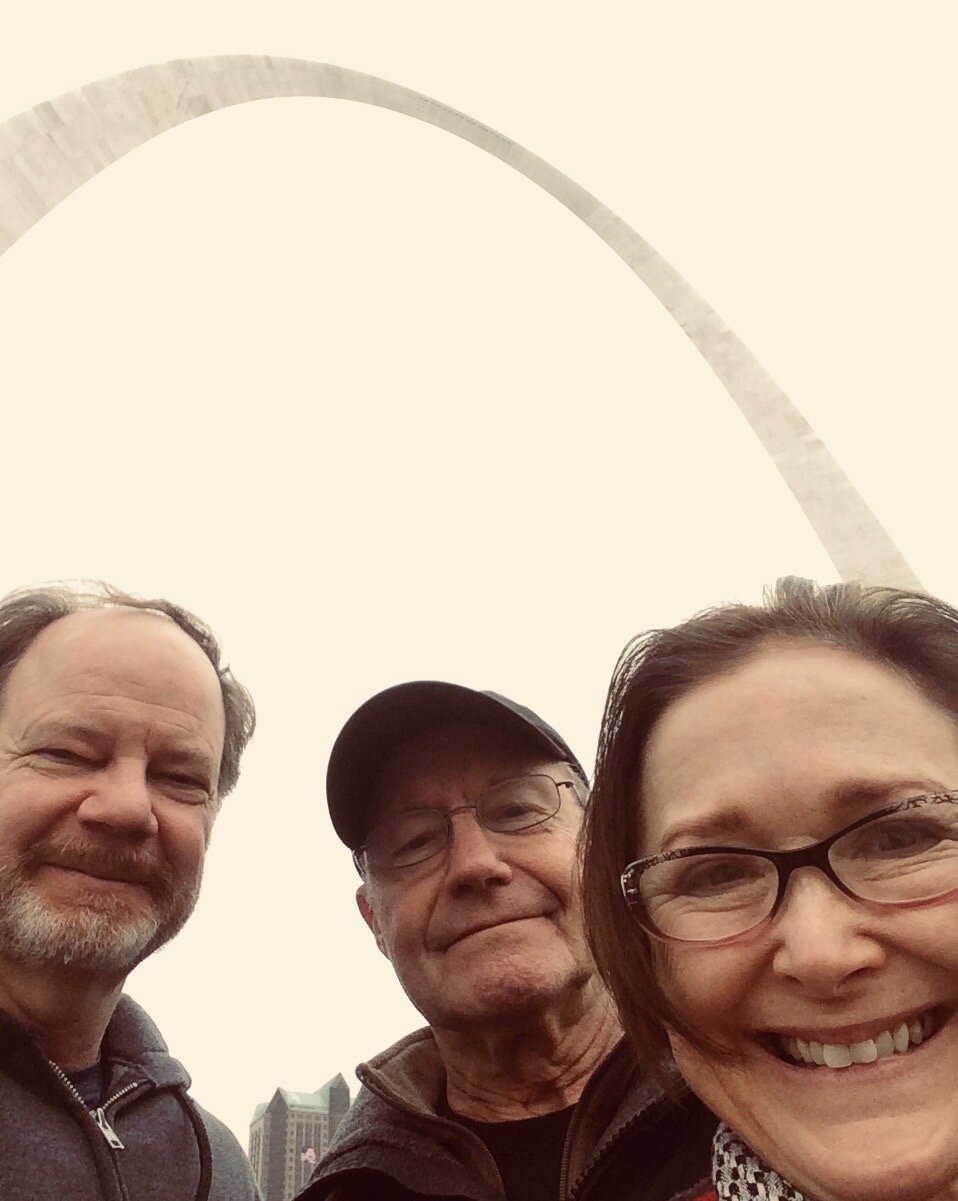
On my last day in St. Louis, Philip Boehm took his old friend and frequent collaborator Steve Carmichael and I on a tour of the city: here we are under Eero Saarinen’s iconic arch. In ten years of working with Upstream, it was Steve’s first day of sightseeing and his first time downtown, so we Canadians have our uses! I also explored the National Blues Museum… and enjoyed talking to the wonderful Ron Himes after seeing him in an outstanding production of August Wilson’s TWO TRAINS RUNNING at his distinguished company, the Black Rep.